

Buying your first home is one of life’s biggest milestones. It’s exciting, but it can also be daunting—especially with today’s housing prices. Luckily, Canada offers several tax credits and savings programs to help first-time buyers make that leap into homeownership. Whether you’re just beginning to save or you’re almost ready to put in an offer, understanding these tools can save you thousands of dollars.
Below, we’ll walk through the key programs: the federal Home Buyers’ Amount, the B.C. Property Transfer Tax Exemption, the First Home Savings Account (FHSA), the RRSP Home Buyers’ Plan (HBP), and the Tax-Free Savings Account (TFSA). By the end, you’ll know how they work, who qualifies, and how to combine them to maximize your savings.
The Federal Home Buyers’ Amount
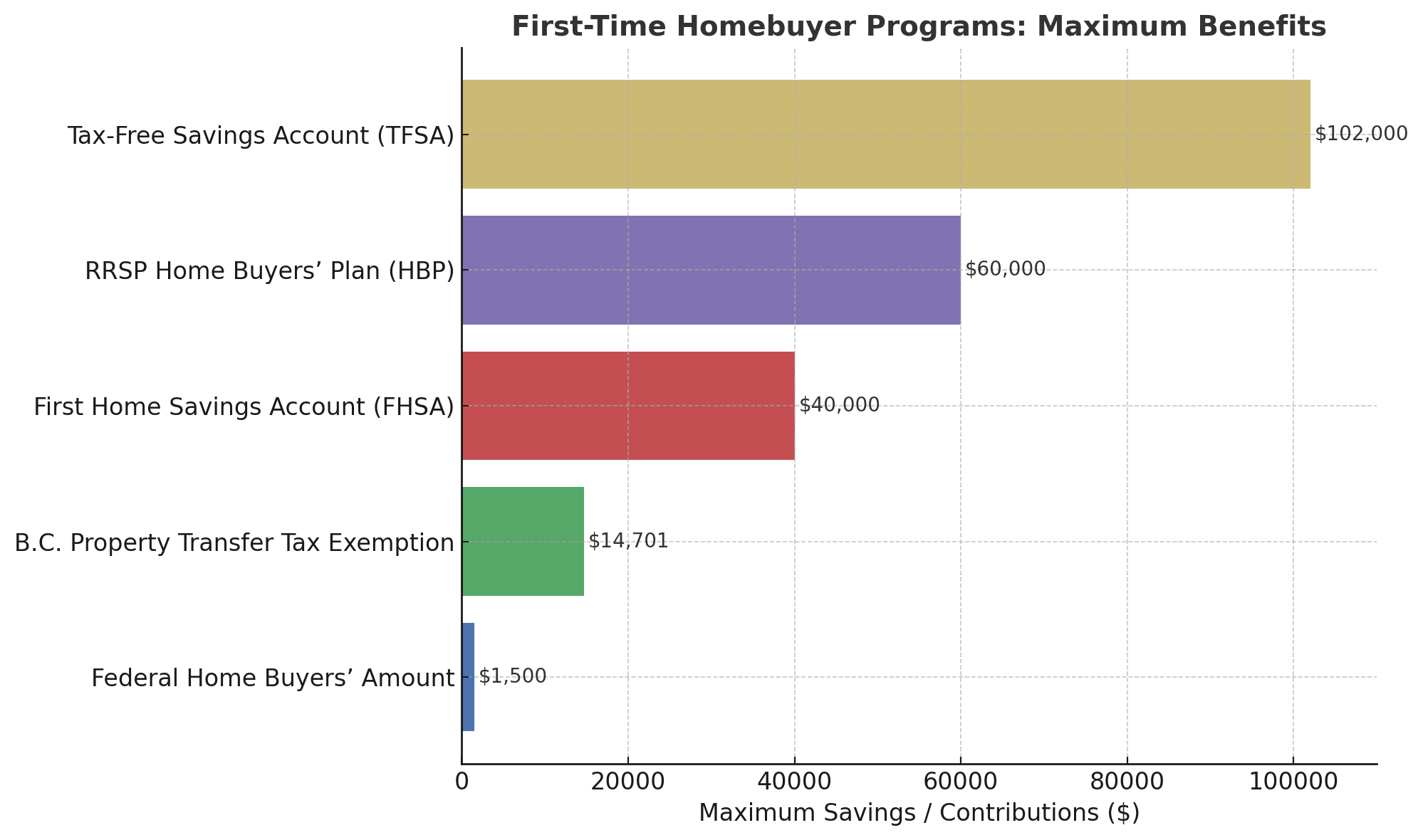
The Home Buyers’ Amount is a non-refundable federal tax credit worth up to $10,000. At a federal rate of 15%, that translates into a maximum tax savings of $1,500.
Who qualifies?
You must be a first-time homebuyer, which means neither you nor your spouse (or common-law partner) has owned a home in the year you buy or in the four previous years. For example, if you plan to buy in 2025, you must not have owned a home since 2020.
An important exception applies if you have a disability. Even if you’ve owned a home in the past four years, you can still claim the credit if you’re buying a home better suited to your needs, such as one with wider doorways, ramps, or no stairs.
What counts as a qualifying home?
Almost any type of residence in Canada qualifies: single-family houses, semi-detached homes, townhouses, mobile homes, condos, or apartments in duplexes and larger buildings.
Couples and claims
The credit can be split between spouses (for example, $5,000 each), but the combined claim cannot exceed $10,000. If only one partner qualifies as a first-time buyer, only that person can claim it.
B.C. Property Transfer Tax Exemption
If you’re buying in British Columbia, the first-time home buyers’ program is arguably even more valuable than the federal credit. It provides a full or partial exemption from the property transfer tax—a provincial tax due when you register your property.
Normally, this tax is:
- 1% on the first $200,000 of the property’s value
- 2% on the value from $200,000 up to $2 million
- 3% on the portion above $2 million
On a home worth $835,000 (the maximum qualifying price as of April 1, 2024), the tax would normally be about $14,701. If you qualify for the program, that entire amount can be waived—nearly 10 times the value of the federal credit.
Who qualifies?
The rules are stricter than the federal program. You must:
- Never have owned a property anywhere in the world that was your principal residence.
- Be a Canadian citizen or permanent resident.
- Have lived in B.C. for at least a year before registering the property or filed two B.C. income tax returns in the last six years.
- Purchase a home valued at $835,000 or less.
First Home Savings Account (FHSA)
Launched in 2023, the FHSA is a game-changer. It combines the tax-deductible contributions of an RRSP with the tax-free withdrawals of a TFSA.
How it works
- You can contribute up to $8,000 per year, with a lifetime limit of $40,000.
- Contributions are tax-deductible (like an RRSP).
- Investment growth is tax-free.
- Withdrawals are completely tax-free if used to purchase a qualifying home.
Example
Say you earn $80,000 per year and contribute $8,000 to your FHSA. You’ll lower your taxable income to $72,000, which could save you about $2,000 on your tax bill that year. When you eventually use the money to buy a home, both your contributions and any growth can be withdrawn without tax.
Rules and timelines
- You must be a Canadian resident and at least 19 (in B.C.).
- You cannot have owned a home in the current or previous four years.
- The account can stay open for 15 years, or until the end of the year you turn 71, whichever comes first.
- Once you withdraw funds for a home, you must close the account within a year.
RRSP Home Buyers’ Plan (HBP)
The Home Buyers’ Plan lets you withdraw up to $60,000 from your RRSP to put toward a home, tax-free—on one condition: you must repay it within 15 years.
Repayment rules
Each year, you must repay 1/15 of the amount you withdrew. If you borrowed the full $60,000, that’s $4,000 per year. If you skip a repayment, the amount becomes taxable income for that year.
How it compares to FHSA
The HBP is useful, but the FHSA is generally more flexible since withdrawals don’t need to be repaid. If you have to choose between the two, maxing out the FHSA first usually makes more sense. That said, using both together can supercharge your down payment savings.
Tax-Free Savings Account (TFSA)
The TFSA has been around since 2009, and by 2025, anyone born in 1991 or earlier could have accumulated $102,000 in contribution room.
Key advantages
- Contributions aren’t tax-deductible, but all growth and withdrawals are tax-free.
- You can withdraw funds for any reason—like a down payment—and re-contribute the amount in a future year.
- Flexibility makes the TFSA especially useful if your timeline to buy is uncertain.
Combining Strategies for Maximum Savings
The best approach is often to layer these programs together:
- Claim the Home Buyers’ Amount for a $1,500 tax savings.
- Use the B.C. exemption (if eligible) to potentially save over $14,000.
- Contribute to an FHSA for deductible contributions and tax-free withdrawals.
- Draw from an RRSP under the HBP if you need additional funds (remembering the repayment obligation).
- Top up with a TFSA, which gives you flexible, tax-free access to savings.
For couples, the savings can be doubled. Each partner can open an FHSA, use the HBP, and contribute to their own TFSA—dramatically increasing the total available for a down payment.
Real-Life Scenarios
- William’s second chance: William sold a home in 2018 after a divorce. Since it has been more than four years, he qualifies again as a “first-time buyer” in 2025. He can claim the federal credit, open an FHSA, and even use the B.C. exemption if he meets residency rules.
- Cynthia’s accessible home: Even though Cynthia already owns a home, she qualifies for the credit because she has a disability and needs a more accessible residence.
- Jacob and Emily’s new start: Emily already owns a condo, but Jacob has never owned a home. When they buy together, Jacob can claim the full Home Buyers’ Amount and contribute to an FHSA.
Key Takeaways
Buying your first home isn’t just about saving every dollar you can—it’s about using every tool available. The federal credit may feel modest at $1,500, but when paired with B.C.’s property tax exemption, the FHSA, HBP, and TFSA, the combined savings can be tens of thousands of dollars.
The key is to plan ahead. Open your FHSA as soon as you’re eligible, contribute regularly, and think strategically about your TFSA and RRSP. When the time comes to buy, you’ll be in the strongest possible position.
✅ Bottom line: First-time buyers in Canada—and especially in B.C.—have powerful programs at their disposal. Understanding and combining them can mean the difference between struggling for a down payment and stepping confidently into your first home.
If you love Langford and you’re interested in choosing Lakeside West as your first home, get in touch with our Sales Team. Their skill and knowledge will help you acheive your home-ownership goals.